Skip to content
Reading Pebbles

children's books and outdoor fun with kids

Cateogries

Archives

Recent Posts

  • The Boy Witch and The Queen of Scots (Blog Tour) April 27, 2024
  • Kevin the Orange Blog Tour March 18, 2024
  • Grim Falls Academy Blog Tour August 21, 2023
  • Scotty Plants a Seed April 27, 2023

Posts by melissacreate

The Boy Witch and The Queen of Scots (Blog Tour)

The Boy Witch and The Queen of Scots (Blog Tour)

Posted on April 27, 2024April 27, 2024 by melissacreate


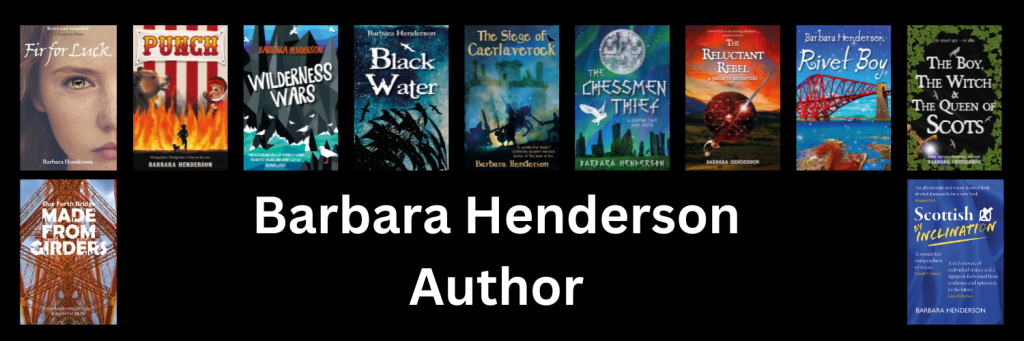
I was super excited to be asked to take part in author Barbara Henderson’s latest blog tour. Thanks so much to publisher Luath Press Ltd for a copy of the book.  I had the huge privilege to participate in Barbara’s blog tour for her first historical fiction book Fir for Luck back in 2016, and then for several other books since.
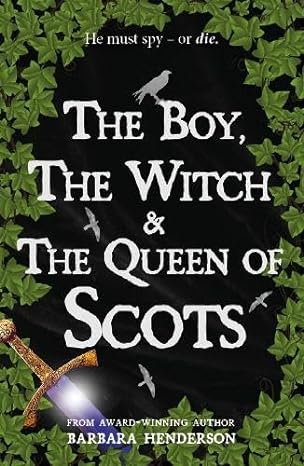
The Boy, the Witch and the Queen of Scots is an eye opening insight into the turbulent period when Mary Queen of Scotts was Queen of Scotland. It begins when she arrives back in Scotland, at the port of Leith in 1561, when she was 18 years old. 

The story draws you in from the very first chapter

The story is told from the unique perspective of Alexander Buchan, a 12 year old falconer. The reader is hooked in from the very beginning as the young man is sent to the docks to collect something, but then through the mist sees the returning Queen’s ship arriving. 
“But then, something catches my eye: a fainter shade of grey, a vessel less defined but sailing into port. No there are two, two galleys, and fine ones at that, though their bright paint work is fog muted..” P12
Alex is the one that alerts others to the arrival of the Queen’s ship (which has arrived a week earlier than expected). But the reader gets alerted to the suggestion that it’s the last thing he wanted, and there is some reason he needs to stay hidden. A terrific way to start a story, which will really draw young readers in.

An fantastic introduction to the conflicts of Tutor Scotland

Soon Alex is send to the Palace of Holyroodhouse in Edinburgh, to assist Mr Kerr, the chief falconer to the Queen. Alex finds himself caught in the middle of the religious wars of the turbulent Tudor era, in which Nobels plot and scheme for power, willing to murder to ensure the religion (Catholic or Protestant) they owe allegiance becomes the dominant one in Scottish politics. Alex has to wrestle with right and wrong. Trying to hold his master the Early of Huntly and the more sister villain of ‘The Cloak’, at bay. He is assisted by a young girl Lizzie, who is employed as a Seamstress for the Queen. 
I highly recommend this book for children aged 9 to 13 years, though many older teenagers and adults with an interest in Scottish history would love it too.

Researching periods of history, reading around the topic

I loved reading this story, as I have several of her other Scottish historical adventures. Barbara has developed a real skill at researching periods of history, as part of the writing process and then identifying a young protagonist from which to tell the story and give a unique perspective on history. 
I was fascinated to read Lucas Maxwell, a librarian in a secondary school interview with Barbara for the Boy the Witch and the Queen blog Tour and have quoted a little piece from it below:
“I immersed myself in reading about the Queen best known for the tragic fate. Reading around the topic without as specific agenda can really help to distill a story.”

Educational resources

Barbara Henderson has created some fabulous teaching resources to go with her book, they can be viewed on her website, see the link at the bottom of this post. This would be a wonderful book to share in the classroom, Barbara has used her expertise as writer and drama teacher in primary schools to give you a wealth of resources to help create rich learning opportunities with this book in the classroom. These resources include:
    • The book has in the endnotes a glossary, historical timeline, and index of people and places
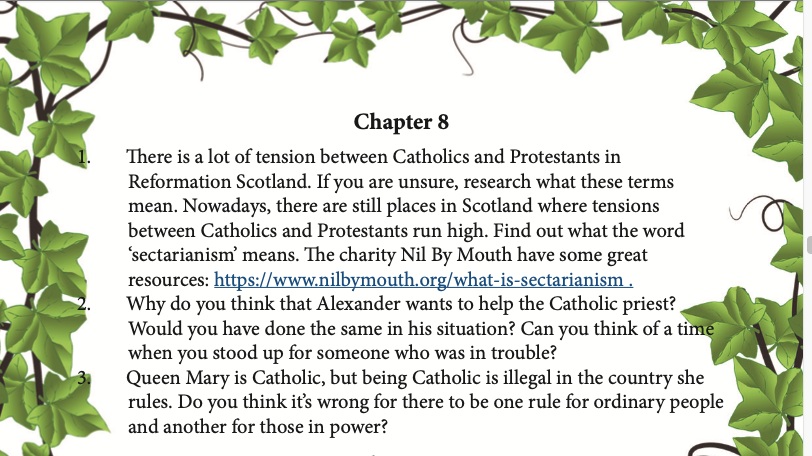
    • The education resources, include a chapter by chapter guide. See the example from chapter 8 below. Which opens up many possibilities to explore the reformation, conflicts between Catholics and Protestants, but also to widen the debate to a broader discussion about ‘sectarianism’. 
    • Events boxes to cut and and arrange in date order
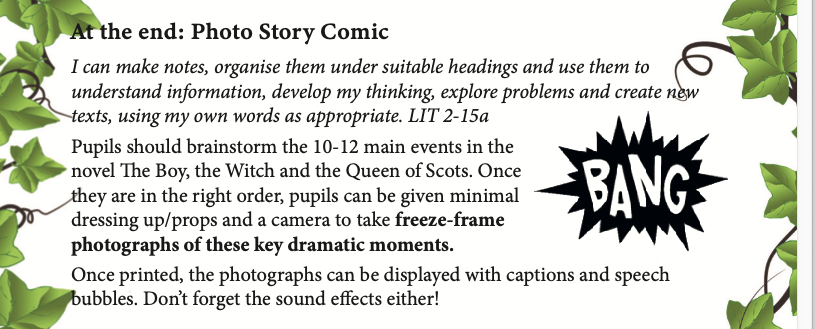
    •   Drawing on her experience as a drama teacher, there are also some great drama based ideas to help students draw out knowledge and understanding from the text. I particular like the idea of freeze framing key events in the story (Photo Story Comic).

You can view and download the  educational resource pack for The Boy Witch and The Queen of Scots here

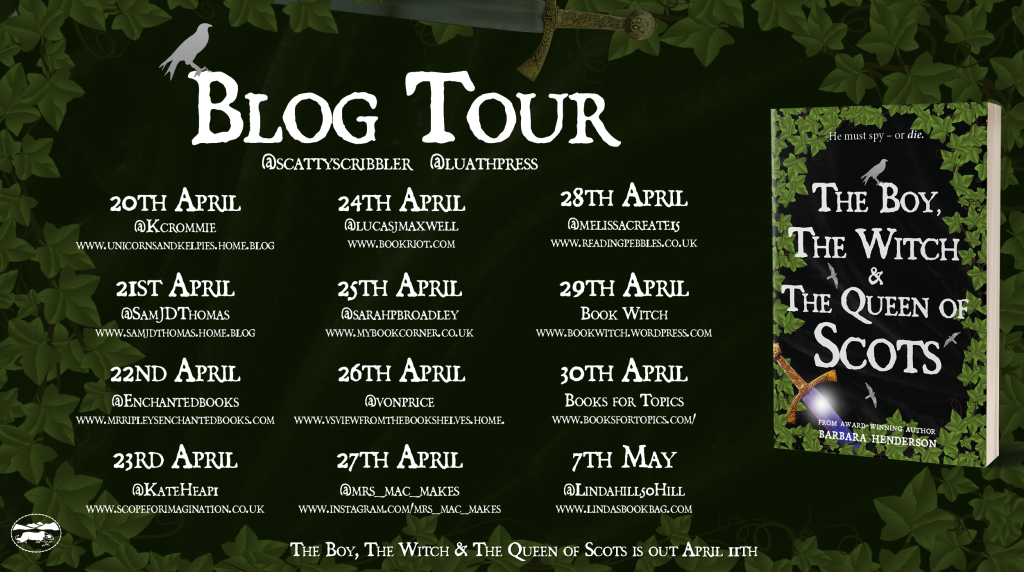
Do check out the other posts on the Blog Tour below. 
 
Kevin the Orange Blog Tour

Kevin the Orange Blog Tour

Posted on March 18, 2024March 19, 2024 by melissacreate

Written by Alan Windram and illustrated by Olla Meyzinger

Thanks so much to publisher Little Door Books for inviting me to review another vibrant, fun, engaging and colourful picture book.
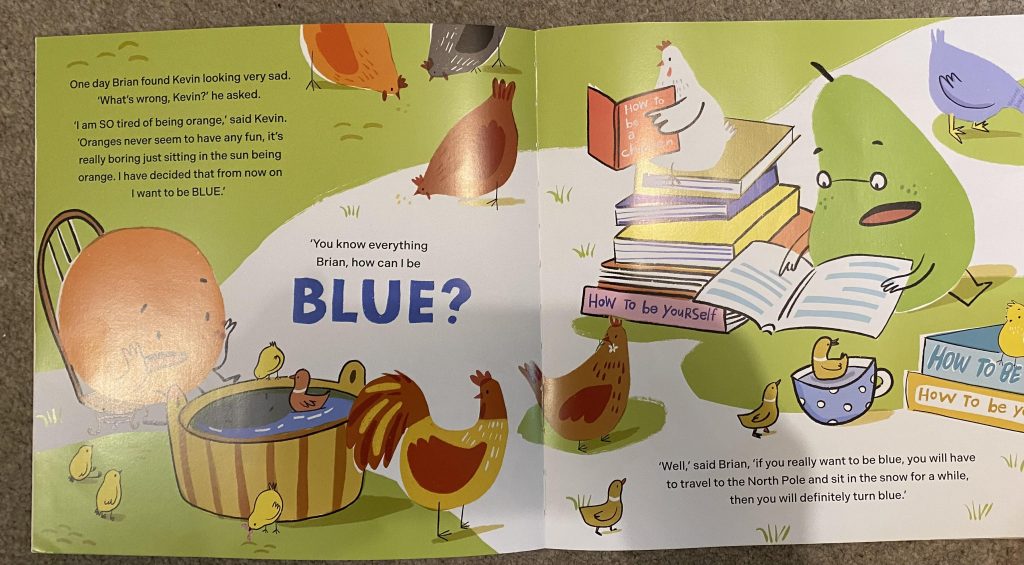
Kevin the Orange is not sure at the start of the story that he wants to be orange so he asks his friend Brian the pear how he can be different colours. Every time he changes to a different colour things don’t quite go to plan and he keeps thinking the next colour will be better. Finally he realises that perhaps being himself, the colour of orange is the best of all. 
A big shout out for illustrator Olla Meyzinger who has done an amazing job with the pictures. They are vibrant and colourful and the expressions and feelings of Kevin and Brian are wonderfully captured on each page. There is also some great detail in the background that helps to set the scene.
I have picked up several picture books recently where a fruit or vegetable is the main character in the story, which offer up some humorous and different perspectives from which to tell a narrative There was something about Olla Meyzinger’s illustrations that I particularly identified with. Then I realised they reminded me of the Garden Gang by Jayne Fisher. I absolutely loved her books as a kid. The premise of the Kevin the Orange is a bit different but there are similarities in the messages of finding out who you are and self acceptance.
Kevin the Orange is a fun, engaging story that will appeal to EYFS and KS1. But, there is also plenty to interest older children and adults. There are many ways a young child could relate to or join in with this story, so it would make a great book to read aloud to encourage a love of stories and books and reading for pleasure. There are also a number of links and possible activities related to this story. It introduces children to colours. Kevin changes colour 6 times (blue, red, yellow, green, pink, purple and white). It also explored hot and cold. Kevin travels to the North Pole to get very cold and eats lots of chilli’s to turn red! A fun, engaging story to read aloud, which also explores themes of friendship, identity and self acceptance.
Grim Falls Academy Blog Tour

Grim Falls Academy Blog Tour

Posted on August 21, 2023August 21, 2023 by melissacreate

Review of Grim Falls Academy by Louise ForShaw


I am delighted to be part of the Grim Falls Academy Blog Tour. Introducing to you a fantastic new series for children aged 7 to 11 years. A  great book for those that prefer a shorter read (each book is about 120 pages). It has the perfect mix of inventive characters, adventures and mishaps, and great character development to keep the interest of all years in KS2. The story is set in a boarding school for monsters, and focuses on three main characters. Seb who is a werewolf, his best friend Victor, who is a vampire bat, and a new student called Tabitha who is probably a human and just discovering her talents. As the title of the first books ‘Don’t Eat the Soup’ suggests, the cooks’ soup causes chaos. I love that the teachers are affected by the soup, leaving the students to sort out the chaos. Unfortunately, this coincides with a school inspection, so Seb, Victor and Tabitha have a race against time to put things right and save the school. But, luckily for the trio they are supported by two ‘enchanted suits of Armour’ called Clunk and Clang, who guard the school.  The school inspector has trouble solving Clunk’s riddle so is delayed at the front door to the school.
I love that the publisher Maverick Books has decided to publish the 3 books in the Grim Falls Academy series at the same time (I really hope there will be more in the series). So that developing readers can keep their interest by jumping straight into the next book. There are a number of things that set this new series apart. Firstly, the way the the story is built up, there is good story telling and plotting and Louise ForShaw perfectly balances introducing the reader to information they need to understand the story with an exciting action packed plot. This is further enhanced by the excellent and well placed illustrations that make this a very readable series. Louise ForShaw is both author and illustrator. She has illustrated many children’s books, this is the first book she has also written. I think her background in illustration has really enabled her to make good use of the illustrations to support the story, which is not always as well done in short reads. The second thing that distinguishes this short read for KS2 is the strength of the characters and the strong friendship between Seb and Victor. 

Exploring Mishaps and character development

As part of my stop on the Blog Tour I wanted introduce you to two aspects that I think Grim Falls Academy does especially well. 
Exploring Mishaps
There are a number of accidents and incidents that happen. So let me introduce you to a few of them.
The incident with the mop
As Seb is rushing to class at the the start of the story he has a run in with a mop, With a combination of text and illustrations this is brilliantly executed. So you have a laugh and feel sorry for one of the main characters.
“Seb was in too much of a hurry to see the sign on the floor. Or the bucket full of soapy water. Or even Brian the zombie caretaker, mopping. That’s why he suddenly found himself with one foot in a bucket, slipping and sliding across the damp floor.
“LOOK OUT!” he wailed, flapping, his arms wildly. But it was too late.”
P11 Grim Falls Academy, Don’t Eat the Soup! (Book 1)
The start of the chaos in the lunch hall 
Absolutely love how the school cafeteria went from calm lunch hall, to chaos in minutes!
“The cafeteria exploded into chaos.
Miss Hallow quickly sprouted two more tentacles that wrestled and grappled with each other, “WHAT’S HAPPENING?! WHAT AM I?IN FACT, WHO AM I?” she wailed. 
Dr Fink the Mad Science teacher, was lying on the floor sobbing with his hand covering his ears….”
P40 Grim Falls Academy, Don’t Eat the Soup! (Book 1)
Character Development: characters that care and want to do their best 
One of the things I love about this series is the care Louise Forshaw takes in developing her characters and the insights she gives into how they are feeling. It is also great that book 1 has profiles of each of the main characters in the book, which would be great for recapping the story, and helping the reader understand the characters. 
Seb being a wererwolf is the perfect opportunity to explore in a broad sense what happens when you get angry. So you get introduced to Seb being frustrated by getting angry in certain situations and trying to control it. 
Another, is when Clang feels he’s a failure because he let the school down with something. I love how the illustrations that go with this tell the reader more and you can see how Seb and Victor are comforting him.
 
There is so much to enjoy in this imaginative new series, full of mishaps and adventures and characters young readers will really warm too. Highly recommend for 7 to 11 years. Do check out the rest of the posts in the blog tour. 
You can support an independent bookseller and purchase from me at Readers that Care.
Check out the other post in the blog tour. 


Scotty Plants a Seed

Scotty Plants a Seed

Posted on April 27, 2023April 27, 2023 by melissacreate

Scotty Plants a Seed by Conn Iggulden and Lizzy Duncan 

Published by Little Door Books 

 
There is more than meet the eye with the fun, engaging and brightly illustrated picture book which is perfect for EYFS and KS1. There is plenty to enjoy and talk about and some good curriculum links with seeds, plants, travelling to different places, deforestation and helping our planet. 
The author and illustrator have created a loveable small black dog. We get a bit of back story at the start, where we learn that Scotty’s mum was washed into the island of Mull in a storm. A while later, the fisherman gives energetic Scotty his mum’s old collar. Which turns out to be no ordinary collar, but a magical travelling collar. The collar takes Scotty and his friend Owl to different places, such as India, Brazil and the African plains. 

Five things I love about this book 

The way a red ribbon is used to signify Scotty is being transported somewhere new with his magical collar. The red ribbon spirals provide a useful connecting thread between the different places, and makes it easier for young readers to spot when Scotty and Owl will be arriving somewhere new.
Love the friendship between dog and Owl and the conversations they have about trees. Great addition of humour with Scotty always trying to pee on the tree and Owl telling him not to! This will really appeal to young children. Also, chasing after Scotty poor Owl looses most of his feathers, which adds humour, but think children with empathise with Owl too. 
The contrasting images between the banyan, Indian tree, the deforested forest in Brazil and the newly planted forest on the African plains. 
On the last two pages Scotty and Owl demonstrate with humour a  simple thing children can do to help. PLANT A SEED!  Plus there are instructions on the final page on how to plant your own seed in a pot. 
There’s a final challenge right at the end of the book. To go back and spot the seed hidden on every page. Making this a great book for sharing with children of different ages. My kids loved searching for things in the pictures together,  when they were younger. 
Check out the other Blog posts on Blog Tour. Thanks to publishers Little Door Books for inviting me to take part.

Grizzly Ben, a picture book by Alan Dapre and Alex Ayliffe

Posted on March 31, 2023March 31, 2023 by melissacreate
 
I was delighted to have the opportunity to review this new picture book by Alan Dapre and Alex Ayliffe, published by Little Door Books.
This is a fun, engaging story with bright and bold illustrations and plenty to interest 3 to 7 year olds. On one level it is a story about a boy called Ben, who got a cuddly teddy bear for this birthday when what he actually wanted was a Grizzly Bear. He takes his new teddy on adventure but abandons him when he gets stuck in a tree. But, then he realised cuddly bear is lonely and rescues him. 
There is also another level to this story.  As Ben gets more and more ‘Grizzly’ he turns into a bear. Which is such a great way of showing to young children what can happen to their mood as they get more and more frustrated, annoyed or disappointed at something or someone, or if they just feel grumpy and are not sure why. The four panel spread BELOW is one of my favourite. The story also givens children the opportunity to discover that a change of perspective and/or taking care of something else can help you to calm down. On the way home Ben cuddles new teddy close (to keep hime safe) and this helps to calm his mood.
What adds a lovely extra layer of humour and emotion to the story is the addition of two of Ben’s others cuddly animals, cat and dog on each of the pages. The illustrator Alex Ayliffe has done such a good job in capturing their reactions and emotions. Young children will love spotting them on each page and there are plenty of opportunities for child to adult conversations about how cat and dog are feeling as well as how Ben is feeling.
If you liked this be sure to check out the Porridge the Tartan Cat series by Alan Dapre. An original first chapter books series, about a cat that gets into all sorts of adventures and mishaps in Scotland and is one of the books that helped my son aged 7/8 get hooked into stories and reading.
 

Available to purchase from me at Readers that Care

Rivet Boy by Barbara Henderson

Rivet Boy by Barbara Henderson

Posted on February 14, 2023February 14, 2023 by melissacreate

Author Barabara Henderson as a child (smallest at front in yellow T-shirt) with family in front of the Forth Bridge.t


I was lucky enough to review, back in 2016 Barbara Henderson’s first middle grade historical fiction book Fir for Luck. It’s therefore with great pleasure and much delight that I accepted an invite to join the blog tour for Rivet Boy.

Rivet boy is based on the Forth River in late Victorian Scotland. It’s about 12 -year old John Nicol. He has to leave school to get a job at the Forth Rail Bridge construction site, he knows it’s dangerous. Several people have already fallen from the bridge into the river below. But, John has no choice – with father gone, he must provide an income for his family – even if he is terrified of heights.

Barbara Henderson has a real skill at giving a voice to children’s experiences of certain events in Scottish history. John was a character that I immediately warmed to, the rich language strikes a great balance between giving insights into how John is feeling and providing descriptive details that immediately take you to another time and place. But, there is so much that will resonate with kids in the Uk today too. From the one bedroom flat John lives in with his sister, mum and grandad, where mum has to sleep on a pull out mattress in an alcove in the kitchen. To John’s concerns about leaving his friends at school and having to deal with cruel gang leaders on the work site.

The story is called Rivet boy, because young boys were used as part of a team of four to put the rivets in, that held the Forth Rail Bridge together. After he’d been trained in the workshop it was John’s job to heat the rivets in a fire, he then passed (or threw) it to the next person, who then quickly put it in the hole and the two remaining people hammered it in place. Sounds tricky enough, try doing that high in the air, above the river Forth.

A riveting historical adventure, that’s both heartwarming and heart-wrenching in places, with plenty of tense moments to keep you reading. But, it is also a story of hope, that gives insights into social and economic disparities of the time and the engineering history of one of Scotlands most important landmarks. The Forth Railway bridge has connected Fife with Edinburgh since it’s construction in 1890. 

John is lucky to make some good friends who help him in a number of ways. The first is Mr Peebles, the Carnegie librarian. I love how John’s treat for his 12th birthday is to go to the library where the librarian (having been clued in an earlier occasion by his mum) is waiting for him with his library membership card, and a book suggestion, Treasure Island. What makes it even more exciting is the story is set only 7 years after Robert Louis Stevenson wrote it. The second friend John’s makes is Cora, the daughter of the man who drives the rescue boat. 
Interwoven, with the danger and hardship of John’s first days working on the Forth construction site, and his daily journeys by train and ferry to work, there’s the touching story of the red squirrel John rescues. He names the squirrel ‘Rusty’ and feeds it crumbs each day in-between his journey on the train and ferry. The squirrel then become a character in his own right in the story, turning up in the most unlikely of places.

Another element that is introduced to the story early on is a parcel that arrives from his Aunt who has emigrated to America. Once again no opportunity is wasted to use it’s arrival to illuminate the circumstances of John’s life.

“She holds a parcel. A parcel? We rarely see the parcel in these parts because non of us are high and mighty enough to merit mail. But, she is right the parcel bears an American stamp.”

In the parcel is a leather bound small book, with blank pages. His Aunt refers to is as an ‘autograph’ book and says that in America some collectors build up quite a collection of autographs from famous people and ‘make a great deal of profit’ when they sell them.

It is an extraordinary insight into the building of an amazing structure and, a thoughtful and engaging insight into a 12 year olds boys daily life, where despite difficulties, hardships and danger with the help of Mr Peebles, Cora and ‘Rusty’ the squirrel, he find’s a way forward.

I highly recommend for 9+ years. A must for any schools in Scotland. But, where ever you live, Rivet Boy is such a great story, if your re-designing your KS2 curriculum, then add in a section on engineering structures and bridges and put this middle grade story centre stage. 

Available to buy from me at Readers that Care

It is currently available as part of my very popular middle graade chapter book bundle. See below. 
 

Book review: Rewilding: Bringing Wildlife back where it belongs

Posted on November 14, 2022November 14, 2022 by melissacreate

David A Steen and Chiara Fedele, published by Neon-Squid

Welcome to my stop on the FCBG News blog tour for Non-Fiction November #NNFN2022

“Rewilding projects are wildlife reintroductions that try to reverse the trend. They bring animals and plants back to areas where they used to live, but that they have disappeared from – usually because we overhunted them or changed their habitat too much”

p1 Rewilding

This is a clearly written and informative non-fiction book, with realistic colour illustrations that help to bring the animals and habitats to life. It gives examples from across the globe, in a range of habitats of the many ways humans have tried to return wildlife to their natural habitats. Neon-Squid the publisher is a relative new comer to children’s non-fiction but their books are definitely worth checking out. 

It raises some interesting questions about the interplay between humans and wildlife, both in creating problems and as positive forces for change. In some locations it recognises that local people are dependent on their local habitat to survive and the need to involve them in decisions about conservation projects.

One of the really special things about this non-fiction book for children is the breadth of mini re-wilding case studies included from all over the world. These include: animals, birds, fish, plants, reptiles and insects and a few plants. Each double page spread focuses on certain aspects that affect a creature or plant and some of the actions humans have taken, working together, to re-introduce them to the wild. These provide examples of hope, that despite the threats to our planet there are things we can do to help.

Some examples of the case studies of re-wilding:

  • Flying a light airplane thousands of miles to try and teach Whooping Cranes brought up in captivity about their annual migration routes.
  • Several examples of the impact of building dams on building wildlife are explored. Such as the: toads dependant on the spray and mist from a gorge in Tanzania (East Africa), and the Chinook salmon affected by a dam in the USA.
  • The idea of keystone species is introduced with two main examples. Beavers in England, and their dam building skills that can help to control a river and protect from flooding. The wolves in Yellowstone park, USA and how the removal of a predator can affect the whole ecosystem.

As well as the case studies there are number of pages throughout the book which explore wider issues relating to habitat preservation and conservation. This provides some good pointers to discuss issues related to re-wilding. In the classroom there’s great potential to use this text alongside a fictional re-wilding story (there are a few suggestions at the end of this post).

There is one small area in which this book could perhaps be improved. I would like to see clearer signposting with different colour headings to more clearly visually distinguish the concept/issue pages from the case study pages, making them easier to find. To assist with this a copy of the contents page is attached with the concept/issue pages highlighted in red. 

I highly recommend this detailed and informative text, with realistic and eye-catching illustrations for 10+ years, to be enjoyed at home and in the classroom. Do check out some of the other non-fiction titles by Neon-Squid the publishers.


Fictional stories about re-wilding

The Rewilders by Lindsay Littleton .  Read my book review here.

The Last Bear by Hannah Wolf 

Fourteen Wolves: A Re-wilding story by Catherine Barr.  A an illustrated narrative non-fiction book about the returning of wolves to Yelloston Park in 1995.

When Things Went Wild by Tom Mitchell.  For a humorous take on re-wilding

This book is available to Order at Readers that Care

The Faber Book of Bedtime Stories, illustrated by Sarah McIntyre

Posted on November 11, 2022November 14, 2022 by melissacreate

Welcome to my stop on the Blog Tour of The Faber Book of Bedtime Stories.  I know when my son was younger there was something special and exciting about having your own illustrated short story collection, this is the kind of book you will want to keep coming back to. There are 17 short stories from 17 authors, including some of my favourite authors.  The stories, are interesting, varied, and full of heart. I am a big fan of Sarah McIntyre, she was a great choice to illustrate this collection. Her bold and eye-catching pictures really stand out and make this  a really special collection.

Anansi and the Curse of the Seven by Ingrid Persaud 

Tell us about your story

Ananci the spider lives in Trinidad and in this story we recount his adventures on a visit to London. While there he discovers the curse of the number seven and uses it to steal yummy pies and cheesy bread rolls. But things get tricky when he tries to get a young boy’s birthday cake and finds himself on the wrong end of the curse.

What was your favourite bedtime story as a child?

I was always asking my daddy to read me Three Billy Goats Gruff or The Three Little Pigs. He made scary faces while he read. It still makes me smile to hear these stories.


Ingrid Persuad’s story features two pigeons and a spider called Anasi. It’s set in London, but the story of the Windrush is cleverly woven into it. Scarlet Pigeon is telling her cousins (who have come to visit from Trinidad) Grand Dove and Anansi about when her farther came to England.

“Now, as I was saying. We have to go back a long time to when my daddy came to England on that big ship, Windrush. Things were hard. They came to London looking for a place to live. They walked up and down looking. But, all they saw were signs saying: NO DARK PIGEONS, DOGS or CATS WELCOME” 

p109 The Faber book of Bedtime Stories

When the two pigeons go on a camping weekend, Anansi is left home alone. He decides to use the curse of seven to trick local kids when they come back from the bakery, so he can eat what they bought! But, then he meets a young boy who is aware of his trickster ways. What will happen then? Read it to find out!

The Visual appearance of this Story collection and Sarah McIntyres illustrations

There are wonderful illustrations by Sarah McIntyre throughout this collections, which really help to bring the stories to life. Sarah McyIntyre has a great skill at portraying the personality of her characters with humour.  I want to highlight two other ways pictures have been used in this collection.  In the Contents page, each of the 17 stories has a picture next to the title. What a great way to build excitement in children of all ages when selecting the next story. This could also be used to make predictions on what each story is about. The second visual clue is each story has a little illustrations either side of the page number, a delightful touch with will also help readers locate each story. 


You can buy from independent bookseller Readers that Care or ask  your local bookshop. 

Check out the other posts in The Faber Book of Bedtime Stories, see below

What’s That? Blog Tour post

Posted on July 21, 2022July 21, 2022 by melissacreate
 
Hi. Robbie I really enjoyed the first book Freddie’s Impossible Dream that you and your dad produced together.
Thanks for the opportunity to talk to you about your new book, What’s That?


1) Can you talk me through your art process, from first idea, first sketch, to final drawing. Perhaps with a few examples from the pictures.  


1) I always start with a pencil sketch, which I ink over when I am happy with it. I don’t draw straight into the computer for the book yet as I am still learning how to use the computer properly and I get my best drawings on paper. My dad then puts it on the computer for me to colour in digitally. Finally, I add shading to give it some depth, and then it is finished. The space picture wasn’t originally in the book. It was supposed to be a matador and my dad decided to change his mind after he read it to some children at school. So he asked me to draw a space scene. I got one of my dad’s books out that had planets in and I tried to draw them as best as I could to make them look realistic. I did draw the planets straight on the computer though, which I am pleased with. My dad was very impressed with them when I showed him.

2a.  How did you decide what Idris and Umo would look like?
2b.  I love the expressions on the kids faces but especially Umo, the girl.  How did you learn about how to draw the different facial expressions?  What tips would you have for other kids?
2)a) Well for Umo, my dad used to teach a girl called Umo and he described what she looked like to me, so I started there. Once I have finished a drawing, I show it to my Dad and Step-Mum and they give me feedback on bits they like and bits they think could be better. If I agree, then I will redraw until we think it is perfect.
 
2)b) I learn mostly from YouTube. I watch lots of videos on how to draw on there. My advice would be to focus on adding the right amount of  wrinkles. Too many and the person looks old. I always look at myself in the mirror doing the expression I am trying to draw. I always find that helpful.


3) Because of the imaginative nature of the story there were many options for the pictures of what you could have drawn. For a few pictures can you tell me about how you decided on what you would draw in that scene?
3) Well, my dad gives me the words that are going on the page and once I read them a picture always just appears in my head and that is what I draw. When I was drawing the pictures for the book I was drawing a lot of realistic characters, so I decided to try to make the cowboy as realistic as I could. With the giant, I decided to add in a beanstalk because I wanted to make it obvious that it was a giant and when I think of a giant I think of Jack and the Beanstalk. I also added mountains in the background to add to the perspective.


4) I know that in your first book Freddie’s Impossible Dream you added a Crab to every page, which added an extra element to the story. 
So I wasn’t surprised to see you had done something similar this time!  But, I wondered what made you choose a worm and a Seagull? (I thought they were a great choice by the way) What do you think they add to the story?
 

4) I chose the seagull (Siago) because we were originally going to have a one in Freddie, but I decided on a crab instead. I chose the worm because I wanted Siago to have a purpose. Crabby is going after the ice-cream so I thought Siago could go after Wormington. I just wanted to add something to the story to make people laugh. That is why I thought Wormington could be running away and hiding from Siago.

Four original non-fiction books on Ancient Egypt

Posted on March 8, 2022March 8, 2022 by melissacreate
 

The topic of Ancient Egypt is one that intrigues me and IT IS a popular choice in primary schools. For this blog post I wanted to highlight some slightly different book on Ancient Egypt. I have focused my choice on ones that text wise are accessible to year 3 and year 4 students, but they will also appeal to older children. 

Meet the Ancient Egyptians - James Davies

The bright, bold and clearly presented style of this book grabbed my attention. This will both capture children’s attention and keep them reading. What I wasn’t expecting is how jam packed with information this small format paperback book is, but with everything laid out in a really accessible way, giving a comprehensive overview of Ancient Egypt. 

There is a map and timeline (at end) and black banners clearly identify the topic covered on each double paged spread, making it easy to skim through the pages to find a topic of interest.

It begins with an almost narrative like introduction to the Nile. Then goes on to cover daily life, including the clothes people wear, and the strange pets they have. Then it explores Pharaohs , gods and goodness, magic and medicine, pyramids and how they bury their dead and what happens in the afterlife. 

The Egyptians: Hide and Seek History - by Jonny Marx and Chaaya Prabhat

A gorgeous colourful lift the flap book on Ancient Egypt. That covers a range of topics, from the archaeologists who study ancient things, pyramids and mummies, and life on the Nile. I loved how the flaps help the reader explore the layers to a sarcophagus and that when you lift the flap of the boat on the Nile it tells you about ports and trading goods. The approach lets the reader take in the bigger picture and then explore nuggets of interesting information in more detail. 

It covers less topics than James Davie’s books, but would be great as engaging introduction to the topic and for children to enjoy together. With 80 flaps to encourage exploring and interaction. 

King Tutankhamun Tells Al l by Chris Nation and Guilherme Karston

The perspective of this book is clever, it is told by the boy King Tutankhamun himself. 

This gives the book a chatty and sometimes humorous edge. The points on each page are broken into bite sized chunks helping to engage the reader. It breaks up well the different aspects to the Kings story, including how he became a boy king, theories on why he’d died early and how Howard Carter discovered the body in a secret tomb. 

Written from the perspective of the boy King, you get some great fun insights into what they had for spiritual security in the after life and ‘dinning with the dead’. There is lots to explore and enjoy in this book. 

If I have one niggle it is that the font its chosen whilst clear is a little curly, which may make it more of a challenge to read for some less confident readers. However, it’s another book that would be great for kids to read together.

Mummies unwrapped by Tom Froese (British Museum, published by Nosy Crow)

My daughter was fascinated by the mummification process when she studied Ancient Egypt in year 4  so a book devoted to this topic got my attention.  This book takes you the entire process of mummification, including information on the embalmers, how the organs are removed and the rebuilding of of the mummy, topics which often aren’t covered in more general texts.

Colourful illustrations help bring the civilisation of Ancient Egypt and is practice of mummification of its dead to life for the readers. With some useful information boxes. However, please note the text level of this book is more difficult than the other three and in longer chunks in places, making it more suitable for year4/5 when reading alone. 


All book are available to order from me at Readers that Care

Older Posts
  • About Me and My Blog
  • About Me and My Blog
Copyright © 2026 Your Name. All rights reserved.